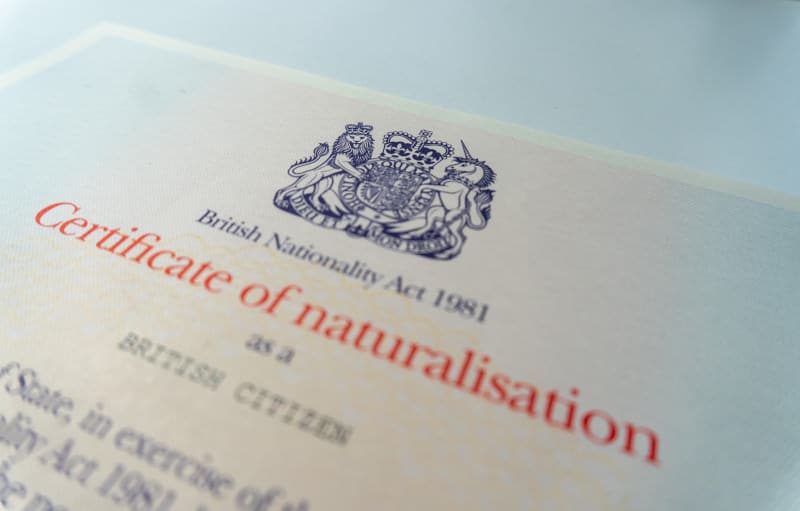


You can apply for British citizenship by naturalisation if you are over the age of 18 and have been granted indefinite leave to remain (ILR) in the UK. The process of gaining British citizenship by naturalisation can be complex, with the requirements varying depending on factors such as whether you are married to a British citizen.
The team at Truth Legal can guide you through the process if you were not born in the UK but wish to become a British citizen. Our expertise in immigration law means that we can explain aspects of naturalisation such as the ‘good character’ requirement, the Life in the UK test and the English language test for UK citizenship.
There are also rules around your total number of absences from the UK during specific periods, as well as fees which need to be paid, documents which have to be presented and a Citizenship ceremony which you have to attend. These are just a few of the issues involved, so whether you’re thinking of starting the British citizenship by naturalisation process or have already started and need some advice, please contact the team at Truth Legal.
Why choose Truth Legal?
The Truth Legal Immigration team is headed by our expert Immigration solicitor, Louis MacWilliam, who has specialised in Immigration matters since 2009.
Louis has vast experience in helping Immigration clients achieve positive outcomes, and training lawyers in Immigration matters. His team of Immigration lawyers are dedicated to their clients, offering exceptional support and specialist knowledge to assist your case.
Truth Legal prides itself on its client care, providing clear and understandable information without the jargon, and practical advice tailored to your personal circumstances. We understand that Immigration matters can be stressful, and so we are here to walk you through the process and make it as smooth as possible until you are holding that visa in your hand.
What’s the Eligibility Criteria for British Citizenship?
The eligibility criteria for British citizenship vary depending upon whether you are married to, or in a civil partnership with, a British citizen. These criteria are statutory and apply to aspects such as:
- Your immigration status
- How long you have been resident in the UK
- Your future intentions with regard to living in the UK
- Your knowledge of the English language and life in the UK
- Your good character
The strict criteria when applying for British citizenship by naturalisation if you are not married to a British citizen are as follows:
- You have been in the UK for at least five years before the application
- You have not been absent from the UK for more than 450 days in the five years directly preceding your application
- You have not been in breach of UK immigration laws at any point during this five year period
- You have not been absent from the UK for more than 90 days during the 12 months immediately preceding your application
- You are not subject to any limit on the period for which you may remain in the UK, and have not been subject to a limit of this kind at any time during the 12 months immediately preceding your application
- You are of good character
- You have sufficient knowledge of the English language (where applicable, this can be the Welsh or Scottish Gaelic language)
- You have passed the Life in the UK test
- If your application is successful your intention is that your home – or principal home – will be in the UK
The strict criteria when applying for British citizenship by naturalisation if you are married, or in a civil partnership with a British citizen, are as follows:
- You have been in the UK for at least three years before the application
- You have not been absent from the UK for more than 270 days in the three years directly preceding your application
- You have not been in breach of UK immigration laws at any point during this three year period
- You have not been absent from the UK for more than 90 days during the 12 months immediately preceding your application
- You are not subject to any limit on the period for which you may remain in the UK on the date of making your application
- You are of good character
- You have sufficient knowledge of the English language (where applicable, this can be the Welsh or Scottish Gaelic language)
- You have passed the Life in the UK test
The Home Office needs to be convinced that you meet all of these criteria when you apply for British citizenship by naturalisation, which is why it’s sensible to take expert advice on the immigration law involved throughout the process.
The ‘good character’ criterion is one which can cause issues as it is somewhat vaguer then the more concrete rules around dates and breaches of immigration law. The requirement for any person who wishes to naturalise as a British citizen to be of good character is contained in the British Nationality Act 1981.
The Act itself doesn’t define ‘good character’ but the Home Office nationality policy guidance sets out how the good character requirement will be assessed. This guidance contains a non-exhaustive list of conduct which will normally be regarded as indicating that an applicant isn’t of good character:
- Criminality – If you have been convicted of a crime or there are reasonable grounds to suspect that you have been involved in a crime
- Terrorism and international crimes such as war crimes, crimes against humanity or genocide – If you have been involved or associated with any of these actions, or other actions not conducive to the public good
- Financial soundness – If your financial affairs have not been in order, i.e. unpaid taxes or excess debt
- Notoriety – If your activities have been notorious and cast doubt on your standing in the community
- Deception and dishonesty – If you have been deceptive in dealings with the UK government, such as falsely claiming benefits
- Immigration-related matters – If you have breached immigration laws while in the UK
- Deprivation – If you have previously been deprived of citizenship
How to Apply for British Citizenship
Once you’re certain that you meet the criteria for making a British citizenship by naturalisation application the next stage of the process is to apply online or by filling in and submitting the application form AN – Application for Naturalisation as a British Citizen. This is a 29 page form which asks for detailed information to prove your eligibility for naturalisation.
You can also apply by post if you live in the Channel Islands, Isle of Man or a British Overseas Territory.
The advice from the Home Office is that you should read Guide AN, a comprehensive guide to the form, before you start to fill it in.
The information required when completing the form includes residency, employment status, biographical information and the details of any dependants also applying. If you are making the application as a spouse or civil partner of a British citizen then you also need to produce evidence of this relationship.
The form also needs to include the details of two referees, and they will need to sign the form to confirm that the information you have provided is true and correct. The detailed information required by the form, or the online application process makes it imperative that you fill it in yourself, in order to ensure that it is accurate and complete.
Applying through an agent or representative
It is possible to apply for British citizenship through an agent or representative. This means a private company or individual can help with the application and provide advice.
Truth Legal is a firm of immigration solicitors regulated by the Solicitors Regulations (SRA) who can assist.
Typically any agent or representative is registered with the SRA or the Immigration Advice Authority (IAA).
When you submit the application form you also need to:
- Submit the relevant documentation
- Pay the required fee
- Provide your biometric information – fingerprint scans and a photograph
We’ll explain the fees for a British citizenship by naturalisation application later in this guide, as well as detailing the documentation which has to be provided.
In order to provide your biometric details you’ll need to attend an appointment at your nearest UK Visa and Citizenship Application Services (UKVCAS) centre. If you wish you can also scan the documentation you are providing during the UKVCAS appointment.
You can find out where your nearest UKVCAS centre is and book an appointment online. You can also upload copies of your documentation as part of the online application process, meaning you don’t have to send the physical documents.
Necessary Documents for Application
When you apply for British citizenship by naturalisation you need to provide a portfolio of documents to prove that you meet the eligibility criteria. The documents you need to provide include:
- Proof of your identity, such as a passport or national identity card
- A letter from the Home Office to prove that you have permission to remain permanently in the UK – i.e. ILR or settled status
- Evidence that you have passed the Life in the UK Test
For evidence that you meet the language requirements. This evidence could take the form of the following:
- A certificate number from an approved testing centre which shows that you have passed an English language test at B1 level
- A UK degree certificate
- Evidence of a Home Office approved qualification in English at B1 CEFR or higher
- A degree certificate taught or researched in a majority English speaking country – this will need to be backed up with an Academic Qualification Level Statement (AQUALS) from Ecctis confirming that the qualification is the equivalent of a UK qualification
- If you have a certificate for a degree taught or researched in a non-majority English speaking country then you will also need an AQUALS and an English Language Proficiency Statement (ELPS)
- If you already met the English language requirement as part of you ILR application then simply send the same documentation as evidence with your naturalisation application
For evidence that you have been continuously resident in the UK for the required period – Residence can usually be proven via a passport, if you had it stamped upon entering the UK. If the passport doesn’t suffice, then you may need to provide alternative proof such as the following:
- A letter from an employer, stating when you started working for them, together with supporting documents like payslips or a P60
- A letter from an educational establishment detailing study periods in the UK
- A letter from a government department which shows that you have ben in the UK for the period in question
- Travel details of any period of absence that you have spent outside the UK
If you are applying for British citizenship by naturalisation on the basis of a marriage or civil partnership to a British citizen, then you will generally be required to provide:
- Your spouse or civil partner’s current passport
- Your marriage or civil partnership certificate
The Home Office will tell you which documents you need to submit once you have made an online application, although their checklists are not always reliable. If you work with the immigration team at Truth Legal we’ll be able to advise whether the documents you’re planning on submitting meet the necessary threshold to avoid to minimise the risk of the application failing.
English Language and Life in the UK Test Requirements
In order to successfully apply for British citizenship by naturalisation you need to prove proficiency in the English language and pass the Life in the UK test. The only people exempt from taking the Life in the UK test are those applicants under the age of 18 or over the age of 65, or those who can prove that there are special circumstances preventing them from taking the test.
The Life in the UK test is designed to make sure that applicants have a broad understanding of British history and culture. The questions cover four main topics:
- UK history
- The British government
- UK geography
- Local culture
The test needs to be taken at an approved test centre. You can find your nearest centre and book a test via the government’s website here. You need to book the test at least three days in advance, and there is a fee which is currently £50.
The test lasts for 45 minutes and consists of 24 questions. It is recommended that you visit the official life in the UK shop online (https://www.officiallifeintheuk.co.uk/shop) when preparing to take the test, in order to access and purchase useful study materials. These include:
- An e-Learning subscription
- An Official Guide for New Residents book
- An Official Practice Questions and Answers book
- An Official Study Guide Book
You will need to score a minimum of 75% in order to pass the test, and if you do you will be issued with a unique reference number to provide when making your naturalisation application. If you don’t pass the test then you can retake it after waiting for at least seven days, although you’ll have to pay the fee again.
Once you have passed the Life in the UK test it remains valid indefinitely. This means that you can take the test at any time in the period prior to making an application for British citizenship.
If you took the Life in the UK test when applying for ILR, then there is no need to take it again when making a citizenship application.
English language requirement
The details of the documentation needed to prove that you meet the English language requirement are set out in the previous section. To summarise, you need to meet the requirements by:
- Passing a CEFR English qualification at a minimum level A1 in speaking and listening
- Holding a degree taught or researched in English
If you are under 18 or over 65, or have a physical or mental condition which would make demonstrating proficiency in the English language prohibitively difficult, then you may be exempt. You are also exempt from the English language requirement if you are from one of the following countries:
- Antigua and Barbuda
- Australia
- The Bahamas
- Barbados
- Belize
- Canada
- Dominica
- Grenada
- Guyana
- Jamaica
- Malta
- New Zealand
- St Kitts and Nevis
- St Lucia
- St Vincent and the Grenadines
- Trinidad and Tobago
- The USA
Fees and Charges
There are fees and charges to pay when applying for British naturalisation:
- The fee when applying for citizenship by naturalisation – £1,605. This will not be refunded if the application is refused or withdrawn.
- The fee for a child under the age of 18 – £1,214
- The fee for your citizenship ceremony – £130. This is included in the overall fee for the application, and will be refunded if the application is refused or withdrawn.
- The fee for taking the Life in the UK test – £50. This is not refunded if you fail the test.
- If you have to sit an approved English language test to meet the English language requirement of the application process, the fee could be more than £150
- You can apply for a duplicate or re-issue of your nationality certificate for a fee of £428, and written confirmation of your status as a British citizen for £459.
- If any of your supporting documents – such as your birth or marriage certificate – are not written in English or Welsh then you will have to pay the cost of obtaining certified translations.
The official fees for the citizenship application process could change over time, so it is important to check the government website for the latest figures.
The expense involved in a British citizenship by naturalisation application is another reason why you are strongly advised to access expert legal advice before and while working through the process. The fact that most of the fees are non-refundable means that even a small mistake in terms of eligibility or documentation could prove to be extremely expensive.
Processing Time and What to Expect
The average processing time for a British citizenship by naturalisation application is three to six months. If your application is going to take longer than six months then the Home Office will inform you of this fact before the six months is up.
If your circumstances change in any way during the period when the application is being processed you should contact UK Visas and Immigration, part of the Home Office, by emailing nationalityenquiries@homeoffice.gov.uk. Changes which need to be reported include a change of address or if you are arrested or get married.
Currently, there is no way to track the progress of your application online, but you can do so by calling UK Visas and Immigration (UKVI) directly on 0300 790 6268. You will need your unique application number when you call.
If your application is successful then you will need to attend a British citizenship ceremony. You will receive an invitation from the Home Office, and must attend the ceremony within three months.
The citizenship ceremony will be organised by your local authority, and you can find details of who to contact on the government’s website here. In most cases you will be allowed to take two guests to your ceremony.
Most citizenship ceremonies take place in groups, but you may be able to arrange a private ceremony with your local authority. Your local authority may charge extra for this.
Dual Citizenship and British Passport Application
Having successfully applied for British citizenship through naturalisation you can apply for a British passport in the same way as any other British citizen. You can also:
- Live work and study in the UK on permanent basis
- Vote in all UK elections
- Stand for office in the UK
- Access NHS treatment and public funds
The UK government recognises dual nationality, meaning that you may be able to hold citizenship of the UK and another country at the same time. The laws with regard to dual nationality differ from country to country, with some nations not allowing citizens to hold more than one nationality.
In the UK you can retain your original citizenship when you become a UK citizen. If the country of which you were originally a citizen doesn’t permit dual citizenship then you will have to renounce your original citizenship when making your application.
The main benefit of this kind of dual citizenship is that you will have the right to live and travel in between both countries. You must also abide by the laws of both countries, and in some circumstances may be subject to double taxation.
The countries which we understand currently allow dual citizenship with the UK include the following:
- Australia
- Canada
- France
- Greece
- Ireland
- Italy
- Pakistan
- Philippines
- Portugal
- Sweden
- United States
Those which currently don’t allow dual citizenship with any country, or only with strictly defined countries, include:
- China
- India
- Indonesia
- Japan
- Malaysia
- Singapore
You should contact the authorities of your home country to check their position on dual nationality.
Handling Application Refusals
Your application for British citizenship by naturalisation could be refused if you fail to meet the statutory requirements set out in this guide. Anything from prolonged absences from the UK to a conviction for a serious criminal offence could lead to an application being refused.
The letter from the UKVI should explain the grounds upon which your application has been refused. If you work with an immigration law expert to ensure that your application and supporting documents provide evidence of you meeting the statutory requirements then a refusal should be avoided.
In some cases, a refusal of an application could be caused by official error. If your application is refused, you have no right to appeal, but you do have the following options:
- You can make a new application for naturalisation. This will mean paying many of the associated fees again, although your English language documentation and proof of passing the Life in the UK test can be carried forward.
- Making a new application could be the recommended way forward if it is clear where your application failed to meet the statutory requirements, and how you can put this right.
- You can ask for the application to be reconsidered. This option will apply if you can show that the decision was incorrect in terms of the law, policy or procedure. The circumstances which might lead to an error of this kind include:
- UKVI not using the right criteria or requirements to make the decision
- UKVI has refused the application on the grounds that you didn’t respond to their enquiries, when in fact you had responded, but this response wasn’t linked to your application
- UKVI reached a decision without giving you sufficient time to respond to any enquiries
- The application was refused on the basis of a criminal conviction which was subsequently quashed on appeal, or involved mistaken identity
- UKVI failed to utilise relevant documentation or information they had possession of
Asking UKVI to reconsider a decision to refuse an application involves an additional charge of £482. If the refusal is subsequently reversed, this fee will be refunded, minus a fee for the citizenship ceremony.
To ask UKVI to reconsider a decision in this way you need to fill in form NR. The form offers the relevant options – as given above – as a reason why the refusal should be reversed.
You will then also need to supply evidence showing, for example, that you had submitted information which UKVI are claiming not to have received, or pointing out the steps you made to contact UKVI, if you feel that the decision has been taken prematurely.
If you’ve had your application for British citizenship by naturalisation refused then we recommend contacting us for advice before deciding whether to ask for the application to be reconsidered or start an entirely new application. We’ll be able to look over your original application and decide:
- Where the UKVI might have made an error, making it worth asking them to reconsider
- If we don’t think the UKVI made an error we’ll be able to see why your application was refused, and what we can do to make the new application more likely to succeed.
Referees for Application
Every application for British citizenship by naturalisation needs to be certified by two referees you have chosen. This means that they have to give their details in part of the application form and sign that the information you have provided is true and accurate.
If you don’t have the signatures of two referees, then your application will be rejected. The criteria for you British citizenship referees are as follows:
- They must have known you for at least three years
- They cannot be related to you, or to each other
- They must not have had any criminal convictions in the ten years preceding your application
One of the referees must be a person of professional standing. The government’s own guidance offers a long list of ‘acceptable professional persons’, including:
- Airline pilot
- Chemist
- Dentist
- Surveyor
- Teacher
- Social worker
The guidance states that one referee must hold a British passport and either have professional standing or be over 25, and that the other can be any nationality but must have professional status.
Neither referee can be employed by UKVI or be a solicitor or agent representing you on this application
Intention to Live in the UK
In order for your naturalisation application to be successful the UKVI need to be convinced – if you are not married or in a civil partnership with a British citizen – that you intend to live in the UK as your main home if your application is approved.
You will have to state this intention on the application form itself, and the UKVI will look at your existing ties to the UK, such as family, work, property or finances. If they feel, on the balance of available evidence, that you have moved the centre of your life to another country, then this may be grounds to refuse your application.
Discretionary Grounds for Citizenship Eligibility
There are some criteria over which the Home Office has some discretion to be flexible. In other words, in some circumstances UKVI might treat an applicant as if they have met a requirement even if they haven’t. These discretionary considerations include the following:
- Permitted absence requirements – i.e. if you have been absent from the UK for more than 90 days in the 12 months preceding the application, or for more than 270 or 450 days in your qualifying period. We have a detailed blog on this tricky area of absences, here.
- The language and Life in the UK test requirements can be waived on the grounds of the age, physical or mental condition of the applicant
- The requirement not to have been in breach of any UK immigration laws in the three or five years preceding your application
- The requirement to have been in the UK at the start of the three or five year qualifying period – there is some limited discretion
Criteria over which there is no discretion whatsoever – and therefore no flexibility, include:
- The requirement to have been granted ILR or settled status
- The requirement to be of good character
If you feel that your application will only succeed, or is more likely to be successful, if some discretion is applied, then it is more important than ever to seek the advice of an expert immigration lawyer at the earliest possible stage.
British Citizenship & Naturalisation FAQs
Further reading
Read our popular articles for more information on British citizenship.